Empowering Families and Future Professionals through Strategic Partnership

Building a resilient community doesn’t happen in a vacuum—it requires a bridge between academic expertise and boots-on-the-ground support. Here in Cobb County, that bridge is being strengthened every day through our proud partnership with Dr. Allison Garefino and the Kennesaw State University Children and Family Programs.

Our collaboration is twofold: while we work hand-in-hand to provide mental health resources to local families, we are also invested in the next generation of providers. Through KSU’s innovative micro-credentialing program, young professionals are entering the workforce with more than just a degree—they are arriving with a ‘shared language’ and the practical tools necessary to make an immediate impact. This month, we sat down with Dr. Garefino to discuss how we are fostering resilience in our neighborhoods and why prepping the workforce of tomorrow is a win for the families of today.
1. Our collaboration is rooted in a shared commitment to the well-being of Cobb County. From your perspective at KSU, how has this partnership specifically amplified the Children and Family Programs’ ability to reach families who might otherwise face barriers to support and resilience resources?
“Wellstar College of Health and Human Services seeks to make a significant contribution to improving the health of individuals, families, communities, and populations locally and globally. Housed within WCHHS, Children and Family Programs’ (CFP) mission is to build healthy communities through evidence-based best practices. I first became familiar with Cobb Collaborative and Irene Barton in 2018 when, as Clinical Director of the CFP, I started to do a survey of community partners, stakeholders, and organizations who had a similar mission. I attended a stakeholder community conversation networking event hosted by the Collaborative and it’s been full steam ahead since then.
Through CFP’s partnership with Cobb Collaborative our reach and impact has grown exponentially. By de-siloing one another’s network of resources and connections, the door is open for the CFP at KSU to be invited to many more local, state and even national tables. We are always warmly welcomed and have created an interconnected web of resources and distribution of best practices into the hands of those who need it most. With Cobb Collaborative’s support, we have been able to bring our evidence-based, trauma-informed best practices to children, their families, and stakeholders in Cobb and surrounding counties, as well participate in working groups with state partners who are making real headway into policy and system level change for mental health and well-being at a statewide level.”
2. Resilience is a core pillar of our work together. How are we currently defining ‘resilience’ for the children and families in our community, and what are the most critical ‘protective factors’ we are helping them build to navigate today’s challenges they may be facing? Any specific stories/examples you’d like to share with this?
“Resilience is often defined as the ability to cope, thrive, and adapt even in the face of challenging events or situations. What we’ve learned about resilience is that it’s something that can be fostered and taught and practiced, not something you’re born with. Our work is rooted in a founding principle that positive, healthy, predictable, stable relationships are a keystone when building protective factors, and have the most benefit for fostering resiliency.
We now know that one of the best predictors of positive, successful, healthy relationships into adulthood, is having at least one trusted adult relationship during childhood. Another critical piece of the resiliency puzzle is feeling connected to a group. For example, at KSU the CFP is fostering resiliency in our student parent and caregiver population, by creating events specifically for them. Given what we know about student parents, they may be underserved in certain areas during their academic career. By helping our student parents recognize that they are a special population, their own social capital, networking, academics, behavioral health and well-being at home have improved. Additionally, their understanding of how to navigate the academic system for themselves and their children has increased. Rising tides lifts all ships, so by taking a whole family approach to our work, we should be affecting change in all areas their lives. Learn more about the parenting support program here. “
3. KSU’s micro-credentialing program is a game-changer for young professionals. Why is establishing a ‘shared language’—common terminology, ethical frameworks, and trauma-informed, evidence-based approaches—so vital before these students ever step foot into the professional workforce?
“Parts of the Georgia school system are currently dealing with lower than expected student success associated with mental health and environmental stressors such as substance use, bullying, truancy, poverty, and other individual and family-lived traumatic experiences. The desert of school-based mental health professionals in Georgia bars schools from responding as they would like to the behavioral needs of children, teachers, and other school staff. Unfortunately, there is a tremendous paucity of resources and support geared towards primary and secondary prevention for youth and children. Current school staff are not necessarily trained in interdisciplinary or integrated approaches to behavioral health and well-being before they are placed in schools. While professional development opportunities allow professionals to receive training in evidence-based best practices, the current heightened need to provide wholistic support to children highlights the importance of equipping emerging professionals from various disciplines before reaching their field. Therefore, not only are more mental health professionals needed to serve Georgia youth, but also more trauma-informed teachers, social workers, and other human service majors able to respond appropriately to health and wellbeing issues.
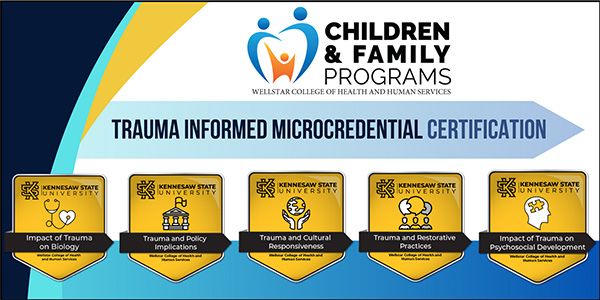
Children and Family Programs and Kennesaw State University (KSU) was uniquely poised and ready to address this need by developing and implementing our Trauma Informed Micro-credentials. https://campus.kennesaw.edu/colleges-departments/wellstar/microcredentials/courses.php
By embedding these micro-credentials into prerequisite courses for Early Childhood (birth- 5 years) and Education (pre-K- 5th grade) majors, as well as our Master of Social Work degree program, KSU is the first University in Georgia to be graduating future teachers and social workers already uniformly trained in the biology, psychology, and policy implications of trauma. These micro-credentials are free, and we hope that KSU will serve as the gold standard for the rest of the USG and TCSG, and everyone is welcome to use these micro-credentials for free.”
4. We often hear about the ‘readiness gap’ in new graduates. How does the specific training and credentialing ensure that KSU students aren’t just academically prepared, but are ‘field-ready’ to handle the complexities of family dynamics and mental health advocacy? Any specific stories of student success you’d like to share?
“Our work to train our undergraduates and graduate students within the Wellstar College of Health and Human services is rooted in career readiness upon graduation. Our micro-credentialing helps ensure that students who may have been novices when enrolling at KSU are essentially experts upon graduation in several areas of how to help support an individual using a whole family approach. They are already armed with a toolkit of how to help in a variety of situations. Each of the five micro-credentials includes a case study that they must work through successfully before earning their micro credential. After taking all five of the modules they earn a certificate in trauma-informed care. I currently have 5 interns and each of them have shared that during their interviews for their year 2 placements, each of their interviewers have expressed how impressed they are at how well trained and versed they are already in ACEs and trauma and real world experience via their field placements even after only one year within KSU’s programs.”
5. Looking ahead, how do you see the integration of community partnerships and specialized academic training evolving? If we are successful in our goals, what does the ‘landscape of care’ look like for a child growing up in Cobb County ten years from now?
“We currently have several public health crises unfolding in Georgia. Anything from the literacy rates of our third graders to the maternal health of the women of our state. We know more so now we can do more. Our work at the University cannot be successful if we only work within our own silos. If we can partner more with the experts in our community and leverage one another’s talents and reach, the success we can have supporting Cobb County would be limitless. Prevention is always wider reaching and less expensive than intervention. If we’re able to lay the tracks now for creating an ecological structuration of best practices and support, imagine where we’ll be six months from now, a year from now, 18 months from now. I would love to see every student graduating from our technical colleges and universities to be trauma informed and ready to support their families and communities. Imagine if the students in the elementary system now, graduate in 10 years with resiliency, having been raised in stable classrooms and families, the impact on our community would be limitless. We’d have a stronger workforce, establishing themselves in a solid community, built on trust, and thriving.”

At the heart of this partnership lies a simple but profound truth: when we align our resources and our language, our community becomes stronger. Whether it’s a family in Cobb County finding the resilience to navigate a difficult season or a KSU student gaining the specialized tools to lead with confidence, the impact of this collaboration ripples outward. We are incredibly grateful for Dr. Garefino’s leadership and the dedication of the Children and Family Programs team. Together, we aren’t just filling gaps in care—we are building a sustainable, expert-led foundation where every child and young professional has the opportunity to thrive.